

Material Passport Systems for Circular Plastics Market: Growing at 13.7% CAGR | Industry Analysis and Forecast By 2036
Material Passport Systems for Circular Plastics Market
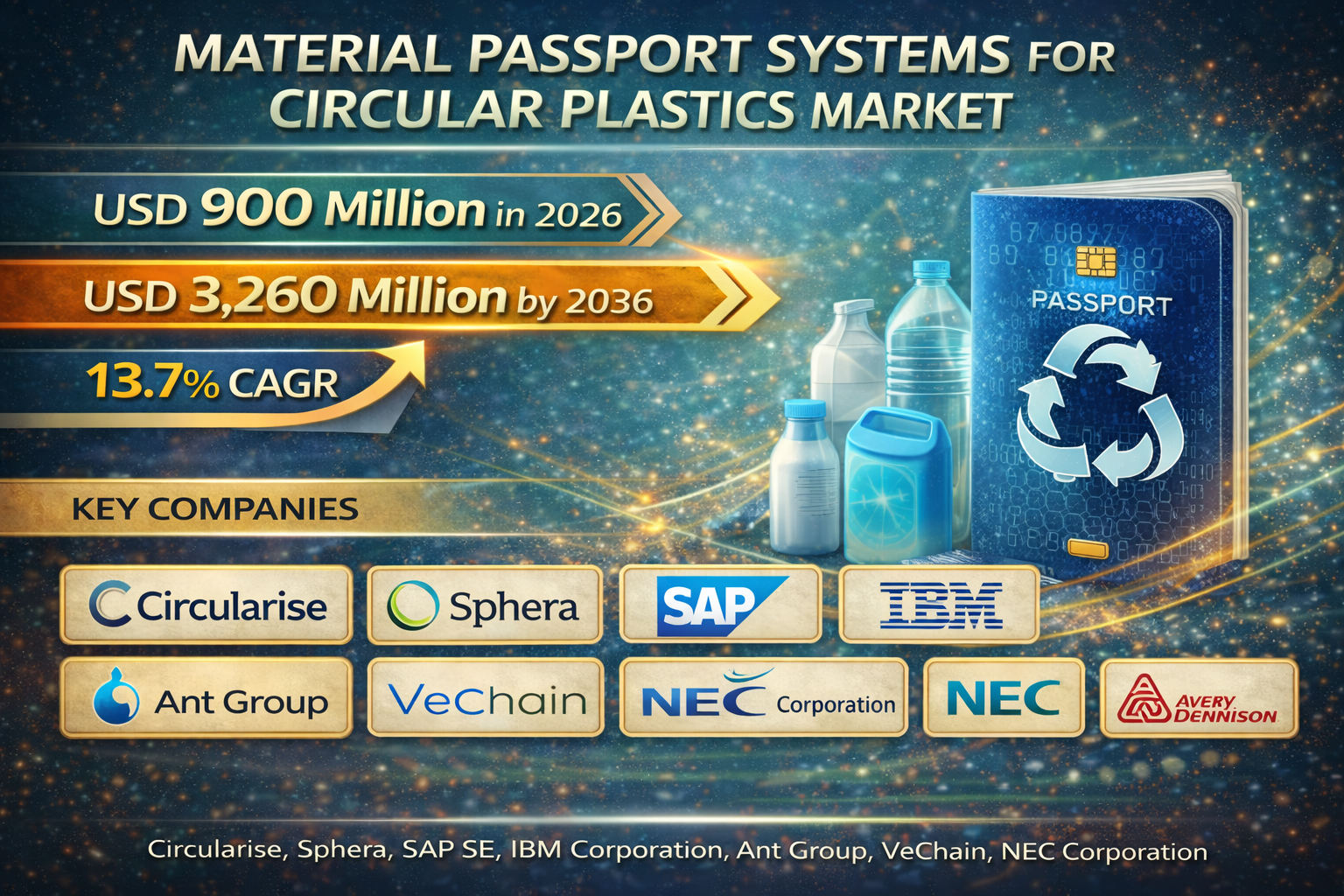
Material passport systems for circular plastics market revenue is projected to total USD 900 mn in 2026, increasing to USD 3,260 mn by 2036, at a CAGR of 13.7%.
NEW YORK, DE, UNITED STATES, February 16, 2026 /EINPresswire.com/ -- The global Material Passport Systems for Circular Plastics Market is projected to grow from USD 900 million in 2026 to USD 3,260 million by 2036, registering a strong CAGR of 13.7%. The market is undergoing a structural transformation from voluntary sustainability disclosure platforms to mandatory, legally enforceable digital systems that directly influence market access, trade eligibility, and cost of capital.
The 2026–2027 period marks a turning point, driven by enforcement of the European Union’s Digital Product Passport (DPP) for packaging. This regulation is catalyzing immediate compliance-driven demand and setting de facto global standards for verifiable recycled content, chain-of-custody documentation, and tamper-resistant material data. Material passports are evolving into auditable, contract-bound data assets that convert sustainability claims into legally defensible proof essential for regulatory compliance, anti-greenwashing litigation defense, and green financing eligibility.
Material Passport Systems for Circular Plastics Market Snapshot (2026–2036)
• Market size in 2026: USD 900 million
• Market size in 2036: USD 3,260 million
• CAGR (2026–2036): 13.7%
• Dominant passport type: Product & Batch-Level Passports (48% share)
• Largest data value pool: PCR-related data (55% share)
• Leading technology: DPP-Compliant Platforms (55% share)
• Leading applications: Packaging & Electronics (45% share)
• Fastest-growing country: India (16.0% CAGR)
• Key companies: Circularise, Sphera, SAP SE, IBM Corporation, Ant Group, VeChain, NEC Corporation, Avery Dennison, Siemens AG, Oracle Corporation
Request For Sample Report | Customize Report | Purchase Full Report - https://www.futuremarketinsights.com/reports/sample/rep-gb-32033
Market Momentum (Structural Evolution)
FMI anticipates a bifurcation of the market into:
Public compliance utilitiesaligned with regulatory frameworks like the EU DPP
Private value-chain optimization toolstailored for high-security and high-value traceability use cases
The market is fragmenting across use cases high-volume packaging applications requiring scalable, low-cost verification versus technical polymers and advanced recycling streams demanding cryptographically secured, forensic-grade traceability. Interoperability is emerging as a primary purchasing criterion. Platforms that align with open DPP data schemas and cross-border audit frameworks are consolidating market share.
Why the Market is Growing
Legal Liability & Anti-Greenwashing Risk: The crystallization of litigation risk particularly around overstated PCR (post-consumer recycled) content claims—has shifted passport adoption from sustainability-led initiatives to legal and compliance mandates. Corporate legal departments now require forensic-grade audit trails to substantiate recycled content declarations.
Trade & Border Mechanisms: Expansion of carbon border measures such as the EU’s Carbon Border Adjustment Mechanism (CBAM) to polymers increases the financial value of verified recycled content. A validated passport can reduce tariff exposure, converting digital traceability into a measurable ROI instrument.
Advanced Recycling & Mass-Balance Complexity: The rise of chemical recycling introduces mass-balance accounting challenges. Passport platforms capable of mapping feedstock allocation and certification workflows are becoming essential for premium pricing and regulatory trust in advanced recycling flows.
Segment Spotlight
1) By Passport Scope
Product & Batch-Level Passports account for 48% of total value, as they anchor specific recycled content and carbon claims to production runs or SKUs. These formats enable liability containment and regulatory audit readiness. Supplier-linked and facility-level passports serve procurement transparency and B2B governance, especially in multi-supplier value chains.
2) By Data Elements
PCR-related data commands 55% of monetized value, positioned at the intersection of regulation, brand premium pricing, and litigation exposure. Accurate PCR attribution directly impacts:
Compliance with mandatory recycled content laws
• Eligibility for fiscal incentives
• ESG-linked financing terms
Competitive differentiation depends on cryptographic validation, mass-balance reconciliation, and secure disclosure mechanisms.
3) By Technology
DPP-compliant platforms account for 55% of market share, reflecting alignment with European regulatory architecture.
Technology categories include:
• DPP-Compliant Platforms
• API-Driven Systems integrated with ERP
• Blockchain + QR-based architectures
• Trusted execution environments
Enterprise ERP integration particularly within SAP S/4HANA environments treats recycled content and compliance evidence as first-class business attributes rather than add-on certifications.
4) By End Use
Packaging and Electronics collectively account for 45% of demand.
• Packaging requires high-throughput, regulator-ready data systems capable of handling millions of SKUs.
• Electronics demands deep integration with serialization, warranty tracking, and repair ecosystems.
Emerging PCR flows and export traceability use cases are expanding rapidly, particularly in Asia-Pacific and trade-driven economies.
Drivers, Opportunities, Trends, Challenges
Drivers:
Mandatory DPP enforcement
• Anti-greenwashing litigation exposure
• Trade tariff mitigation mechanisms
• Green financing criteria
Opportunities:
Passport-as-a-Service models for SMEs
• Integration with digital watermarks (HolyGrail 2.0-type initiatives)
• Bio-based polymer traceability
• ESG-linked premium pricing
Trends:
Weaponization of sustainability data in litigation
• Verticalized sector-specific passport platforms
• Interoperable open-data ecosystems
• Convergence of physical and digital markers
Challenges:
Fragmented upstream waste data
• High onboarding cost for SMEs
• Interoperability across jurisdictions
• Data sovereignty and localization constraints
Competitive Landscape
Competitive intensity is rising as material passports become foundational infrastructure within the circular plastics economy.
Strategic directions include:
• Verticalization into packaging, automotive, and electronics sectors
• API-based ERP integration
• Cryptographically verifiable PCR attribution
• Audit-ready documentation frameworks
• Cost-efficient verification for high-volume packaging streams
Enterprise infrastructure leaders such as SAP SE and IBM Corporation are embedding passport logic into broader supply chain ecosystems, while specialist providers like Circularise focus on mass-balance traceability and DPP readiness.
The long-term winners will be platforms that combine interoperability, cryptographic trust, low-cost scalability, and regulatory alignment.
Why FMI: https://www.futuremarketinsights.com/why-fmi
Have a Look at Related Research Reports on the Packaging Domain:
PET Bottles Market: https://www.futuremarketinsights.com/reports/pet-bottles-market
Protective Packaging Market: https://www.futuremarketinsights.com/reports/protective-packaging-market
Old Corrugated Container (OCC) Market: https://www.futuremarketinsights.com/reports/old-corrugated-containers-market
About Future Market Insights (FMI)
Future Market Insights, Inc. (FMI) is an ESOMAR-certified, ISO 9001:2015 market research and consulting organization, trusted by Fortune 500 clients and global enterprises. With operations in the U.S., UK, India, and Dubai, FMI provides data-backed insights and strategic intelligence across 30+ industries and 1200 markets worldwide.
Sudip Saha
Future Market Insights Inc.
+1 347-918-3531
email us here
Legal Disclaimer:
EIN Presswire provides this news content "as is" without warranty of any kind. We do not accept any responsibility or liability for the accuracy, content, images, videos, licenses, completeness, legality, or reliability of the information contained in this article. If you have any complaints or copyright issues related to this article, kindly contact the author above.
